The origin of the word Carnival goes back to the Middle Ages and undoubtedly comes from the terms “carne levare” meaning “to remove meat”.
Key Dates
1294
When the Count of Provence, Charles of Anjou, announced that he had spent “the joyful days of Carnival” there.
1539
The organization and regulation of festivities were entrusted to the “abbés of fools” who organized four balls in the city according to social classes: nobles, merchants, artisans, and workers.
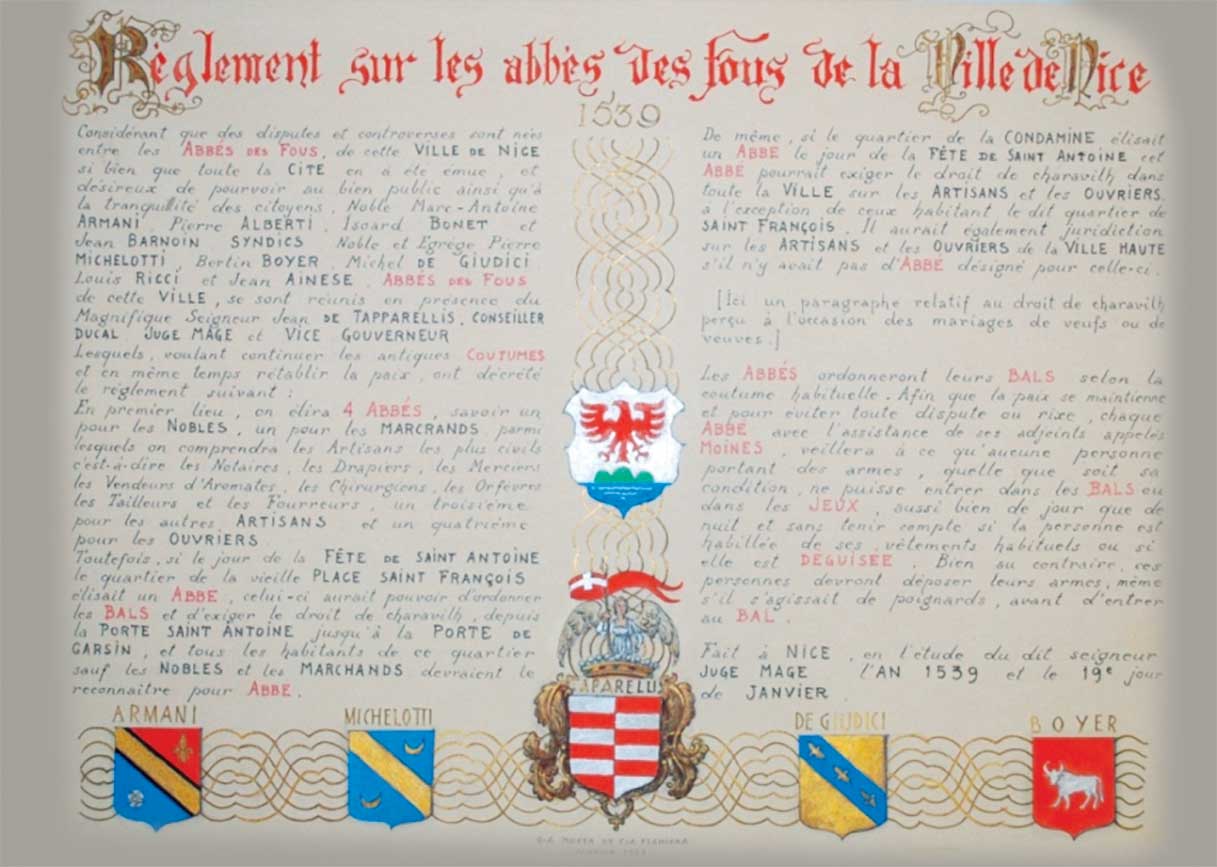
Collection Musée Masséna
1830
At that time, Nice became the “capital of winter vacation”.
During the winter stay of the King of Piedmont-Sardinia, Charles-Félix, the local notables organized the Carnival on Cours Saleya with carriages and a gala parade under the palace balcony.
1860
At that time, the crowd threw plaster confetti, called “Italian confetti.” Paper confetti or “Paris confetti” appeared in Nice in 1892.

Collection Musée Masséna
1873
The Niçois Andriot Saëtone founded a Carnival committee to promote the city of Nice and attract wealthy winter visitors. Organized under the municipality’s patronage, the carnival became a real spectacle with floats, masquerades, cavalcades…
Thus, on February 23, 1873, Carnival 1st entered the city, marking the birth of the modern carnival. Alexis Mossa and his son Gustave Adolf structured the staging until 1971, adding a unique touch mixing current events, allegorical myths, and grotesques. They created spectacular float models recognized as intangible heritage by UNESCO.
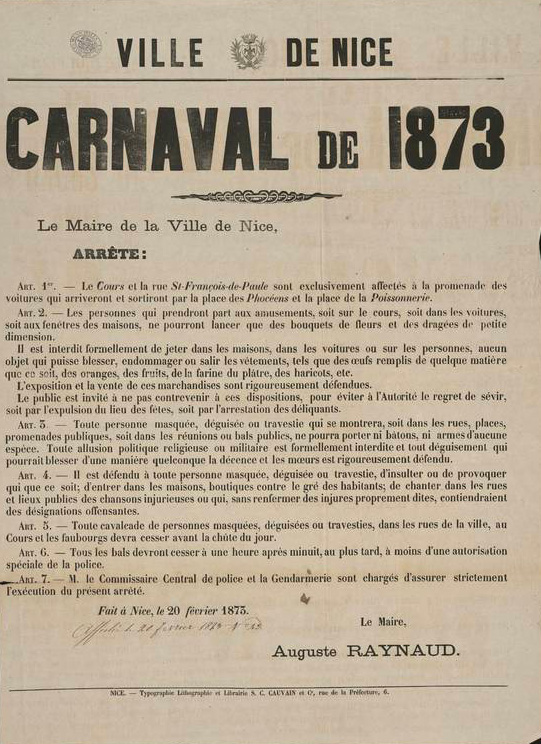
NCA Archives Collection
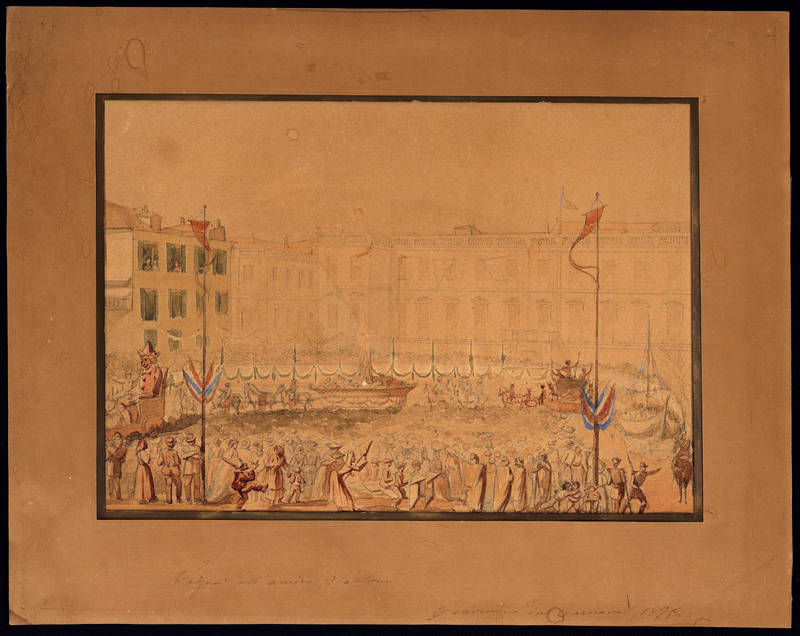
NCA Archives Collection
1876
The Flower Battle was born. Initially, it was an exchange of flowers, but it became the poetic and elegant side of the Carnival highlighting local production. A unique show worldwide, thanks to the imagination of the poet-gardener Alphonse Karr.
February 14, 1882
King Polichinelle, previously a stationary straw puppet on the Prefecture square, transformed into “Triboulet” and participated for the first time in the parade on the “royal float.” The parades with several routes continued in the neighborhoods with small floats created for the occasion.
1889
1st Carnival poster.
World War I and II
Due to the conflicts, the carnival was canceled for the entire duration of the two wars.
This was also the case in 1991 due to the Gulf War.
1964
1st mechanized floats.
2005
Since that date, the theme of the Flower Battle coincides with that of the carnival.
2019
The City of Nice resumed direct management of the Carnival organization.
