The master creators behind nice carnival
A family story
From 1873, the floats and giant heads were built by passionate volunteers from Nice who carried out various activities: firefighters, chimney sweeps, insurers, traders, civil servants, insurance agents… They were the carnival creators.
In 1922, they gathered into 4 associations: the Association of Carnival Builders, the Aces, the Artisans and the Union.
Until 1995, the carnival creators devoted their leisure time to creating the carnival.
The transmission of this popular art has long been based on a system of kinship-cooption. In this way, the carnival creators are essentially families: Belgrano, Durand, Faraut, Depo, Pedemonte, Pignataro, Povigna, Sidro, Signorelli, Trimarco, Vitali, etc.
In 1995, Nice Tourist Office took over organising the Carnival from the Festival Committee. The new management standards encouraged the carnival creators to group together into professional societies for the benefit of the Carnival.
Today, there are 5 companies :
- Constructions Carnavalesques (famille Durand);
- Carnaval Story (famille Ruzziconi);
- Concept Événementiel (Pierre Povigna);
- France Festivités (Gilles Povigna);
- Nice Festivités (Cédric Pigna taro);
Every year, the Nice Carnival involves about forty carnival artisans working with carnival families.
In 2019, the craftsmanship associated with our Carnival was included in the national inventory of intangible cultural heritage in France by the Ministry of Culture.
Building a float
Discover step by step how the carnival parade is put together ! A whole year of work by the various trades.
Sculpture
Floats and giant heads come to life when the sculptor models the faces with clay. Then, they make the plaster mould which the carnival creator covers with several layers of paper cut into small pieces and glued with a mixture of flour and hot water, to give the final model, in cardboard paste, which is then painted and dressed.
The head of the King and his subjects are also made with polystyrene and foam by the sculptors.
The giant heads, formerly made of pasteboard and built from clay moulds, are nowadays made of polyester resin, but the carnival creators remain faithful to “traditional” uses: they make the giant heads from a clay mould and then create it out of pasteboard (layers of newspaper or brown paper, to which postcard paper is added to solidify the whole thing). Making giant heads from these traditional materials is part of the passion of some of the creators.
In 2019, a high-tech artistic revolution was introduced into the Nice Carnival. The Povigna creators equipped themselves with an ultra-sophisticated robot which has a very long arm to make perfect heads, sculpted from huge blocks of polystyrene.

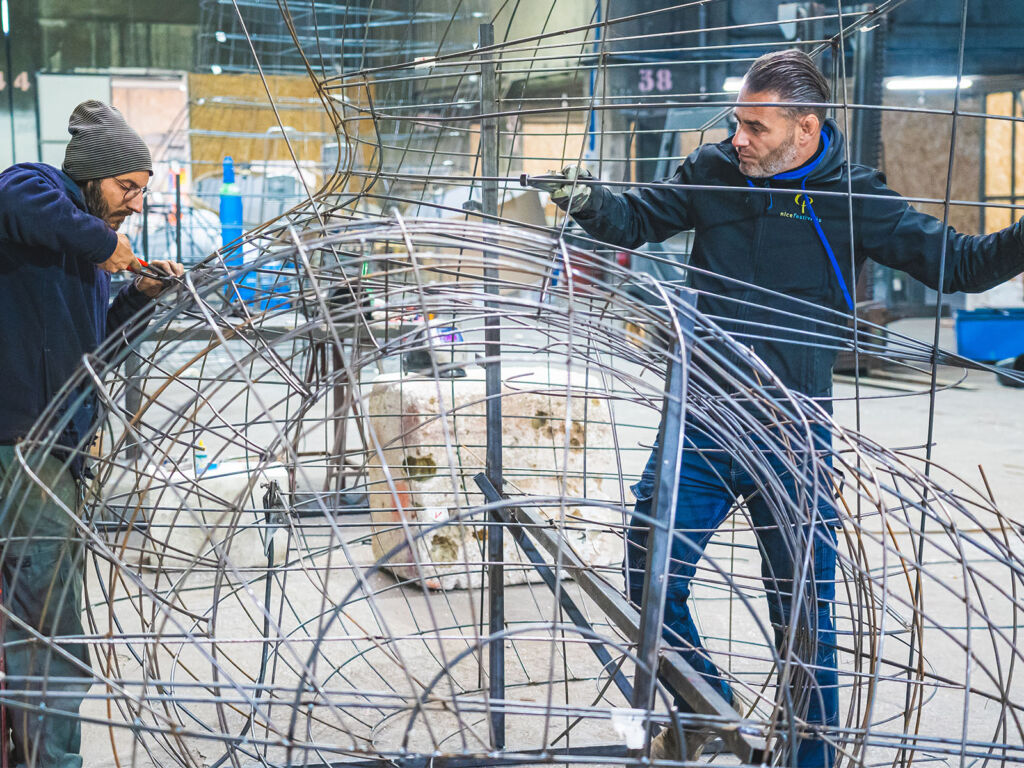
Metal framework
The craftsmen use smooth iron to make the metal framework, the “skeleton” of the float. This is worked using a tool commonly referred to as a “claw” by ironworkers, known as “serruriers”. The iron is worked with the “claw”, following the worked forms, drawn with chalk on the ground.
At the end of the 19th century, floats were operated by pulleys and ropes. From the 1960s, wiper motors and hydraulic cylinders allowed considerable progress in bringing the characters to life.
Bright, fanciful colours
In a step called “pastissage” or “covering”, the polystyrene sculptures are covered by the craftsmen with layers of glued paper and kraft paper.
Then, an undercoat of white paint is applied, with a roller, small roller, brush or airbrush. The airbrush, or “gun”, produces reflection effects or covers delicate contours, such as those of the faces, with paint. Finally, they use the brush for the most detailed parts.
Dressing
The non-sculpted parts, in metal strapping, are covered with the float’s decoration. The costumes of the float characters are created by a costume designer, assisted by one or more seamstresses. The costumes are made of fabric, attached to the float using Velcro strips.
It took 80 metres of fabric to make the King’s costume in 1965, while today it takes 200 !
Assembly
The sculptures are made up of several pieces assembled on the platform of the float using a winch and attachment system. For the tallest floats like that of the king, a crane is used to position the king’s head, assembled externally.
This moment marks completion of preparing the floats and the start of the carnival.


From string to artificial intelligence
The carnival creators are enthusiasts passionate about the search for movement. They show remarkable ingenuity that has seen them evolve from manual animation via strings, to the use of small wiper motors, to hydraulic cylinders that can animate giant subjects more than 15 metres tall, to achieve ultra-sophistication with a robot capable of entirely sculpting a subject using new technologies.
Production locations
The « maison du Carnaval »
The main construction workshop, in the Riquier district, is called the “Maison du Carnaval” (Carnival House), specifically dedicated to carnival constructions. Each society has its assembly and work space.
The historical place for manufacturing floats in Nice, this hangar has existed since the 1930s and remains the manufacturing epicentre for the carnival.
Experienced carnival creators, over 70 years old and expert in the profession, can testify to this: “I’ve always known the carnival to be here.“
Here in the Riquier district, a place of history for craftsmen and historic district of carnival creators, they used to build their floats in wooden structures called “barracks”.
The « halle Spada »
Designed by the architect Honoré Toscan, this is a very large reinforced concrete hall covered with a metal frame with transparent sections. Located on the edge of Avenue Denis Séméria, in the Saint-Roch district, in Nice Est, Halle Spada is home to the large family of carnival creators. Here, smells of paint and glue fill the air.
The activity is punctuated by the sound of metal to be assembled, cuts of wood or polystyrene being sculpted… not to mention the constant clicks of sewing machines operated by costume makers and the rustling of kilometers of fabric. The workshop sounds make up the main symphony.
Everything is oversized. At the heart of the 16,000 m2 space, the trucks are stored like babies’ prams, the constituent parts of the floats are created and mounted more than 10 metres high. Entering the hall produces a magical effect, an “Alice in Wonderland” version. Once through the door, the visitor turns into a Lilliputian and strolls through the heart of an enchanted, psychedelic world.


